
Industry Secrets: Choosing Between Natural, Lab-Grown, Moissanite, and CZ
An industry insider explains the definitive differences between Natural Diamonds, Lab-Grown Diamonds, Moissanite, and CZ. Learn how to choose the right stone for your budget and style.

After 5 years in the jewelry industry—3 years focusing on natural diamonds and 2 years in lab-grown diamonds—I’ve seen it all. This guide is a deep dive into the real differences between Natural Diamonds, Lab-Grown Diamonds, Moissanite, and Cubic Zirconia (CZ).
The Reality of Natural Diamonds
From mining and sorting to transportation and cutting, every step of a natural diamond's journey requires immense resources. While the 'Blood Diamond' narrative gave us a glimpse into the production cost, the retail markup is often the real 'intelligence tax' for brand-indifferent consumers. A 0.3ct ring worth 6k priced at 34k? That's where you need to choose wisely based on your actual needs: the proposal, the wedding, or daily wear.
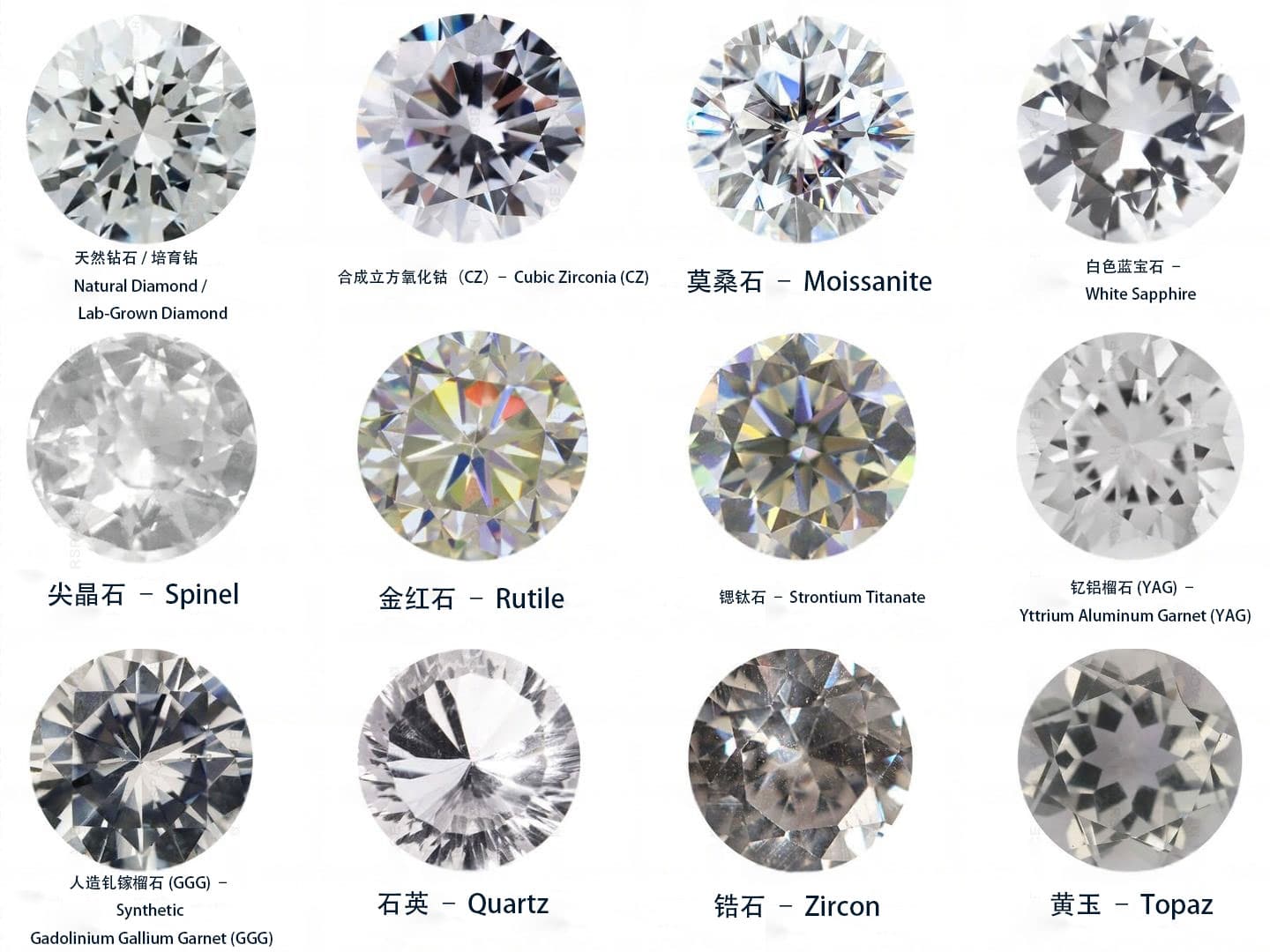
1. Lab-Grown Diamonds: The Chemical Twin
Lab-grown diamonds are physically and chemically identical to natural diamonds. They are categorized into two types based on their growth method: CVD and HPHT.
• CVD (Chemical Vapor Deposition): Best for F-H color, high clarity (VVS-VS), and 3EX cut. Look for the wavy growth lines under 10x magnification.
• HPHT (High Pressure High Temperature): Ideal for D-E color levels as they don't require color treatment. These have fewer metallic inclusions and low magnetism.
2. Cubic Zirconia (CZ): The Industrial Challenger
| Property | Natural Diamond | Cubic Zirconia (CZ) |
|---|---|---|
| Dispersion (Fire) | 0.044 | 0.060 |
| Hardness | 10 | 8.5 - 9.0 |
| Density | 3.52 | 5.6 - 6.0 |
| Refractive Index | 2.417 | 2.176 |
CZ was designed to replace diamonds with better fire and clarity at a fraction of the cost. However, luxury is built on history and scarcity—something mass-produced CZ can't replicate.
Pro Tip for DIY testing: 1. A line drawn with a ballpoint pen stays solid on a diamond. 2. Place the stone over a line drawn on paper; if you can't see the line through it, it's likely a diamond.
3. Moissanite: The Rainbow Sparkle
| Property | Natural Diamond | Moissanite |
|---|---|---|
| Dispersion (Fire) | 0.044 | 0.104 |
| Hardness | 10 | 9.25 |
| Density | 3.52 | 3.22 |
| Refractive Index | 2.417 | 2.65 - 2.69 |
Moissanite is famous for its extreme 'fire.' Due to double refraction, it can sometimes appear slightly 'milky' or less transparent than a diamond. Beware of unstable pricing; high-quality Moissanite shouldn't turn yellow or cloudy. If it does, it was likely acid-washed to artificially boost its initial appearance.
At ainostore, our goal is to empower jewelry enthusiasts like you to make informed choices and find the pieces you love—whether it’s for a wedding, a gift for someone special, a surprise for your girlfriend, or just a treat for yourself. While we don’t currently carry high-end luxury jewelry, we offer a wide variety of styles, and we hope you’ll think of us whenever you’re searching for fresh, new designs. We can’t wait to welcome you!
Featured Collection
More from Maison Lumière
Industry Secrets: Choosing Between Natural, Lab-Grown, Moissanite, and CZ
An industry insider explains the definitive differences between Natural Diamonds, Lab-Grown Diamonds, Moissanite, and CZ. Learn how to choose the right stone for your budget and style.

The Essential Guide to Jewelry Materials: From S925 to 18K Gold
Demystifying jewelry materials: From the S925 hallmark to the durability of Titanium steel and the luxury of 18K gold. Everything you need to know before your next purchase.

How to Keep Your Pearls Glowing: The Definitive Maintenance Guide
Unlock the secrets to lifelong pearl luster. Learn why pearls "breathe," the critical things to avoid, and the professional "Last On, First Off" styling rule.
The Golden Ember: Rediscovering Tiger’s Eye in Modern Minimalist Design
Explore the captivating allure of Tiger’s Eye. From its ancient protective origins to its place in the modern professional's wardrobe, discover why this chatoyant gemstone is the season's must-have neutral.
Here, pearls can be "artificial" - Zhuji Pearls
Explore Zhuji, Zhejiang, China—the city that supplies 80% of the world's freshwater pearls. From the pearl cultivation ponds of Shanxiahu to the high-end jewelry workshops in Paris, we will delve into the science and history of cultured pearls.

The World's Most Coveted: Top 6 Most Expensive Gemstones of 2024
Dive into the elite world of high-stakes gemology. From the deep blues of the ocean to the rarest reds, we rank the six most expensive gemstones on the planet today.